- a Randomizer class that generates random timed events
- can be used for things like:
- random character eye blinking
- random monster spawning
- random shooting stars (we'll examine this example)
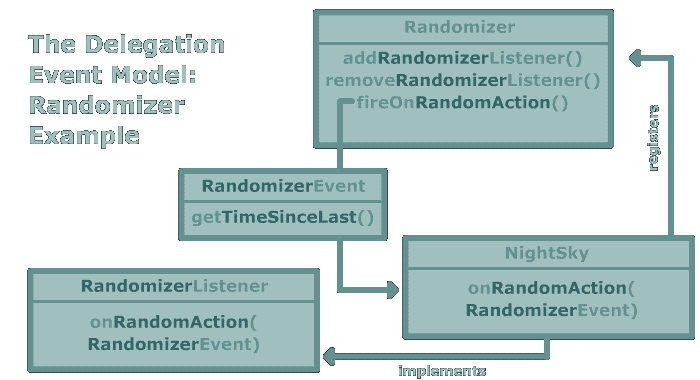
- Randomizer is the event source
- RandomizerEvent is the event object
- RandomizerListener is the interface
- NightSky is the event listener
// PACKAGE
AsSetupPackage("org.moock.util");

// CLASS Randomizer

/**
 * Generates random events.
 *
 * @param  interval  The time in milliseconds to wait between
 *                   checks for a random event.
 * @param  odds      The likelihood an event will be triggered at
 *                   each check. An event has a 1 in odds chance of
 *                   being triggered.
 */
org.moock.util.Randomizer = function (interval, odds) {
    // Initialize the time of the most recent event.
    this.lastEventTime = new Date();
    // Start checking for events.
    this.start(interval, odds);
    // Create an EventListenerList to manage listeners.
    this.listenerList = new org.moock.event.EventListenerList();
}

// PROPERTIES
  // The event listeners that will receive events.
  org.moock.util.Randomizer.prototype.listenerList = null;
  // The time in milliseconds between checks for a random event.
  org.moock.util.Randomizer.prototype.randInterval = null;
  // The time of the last random event.
  org.moock.util.Randomizer.prototype.lastEventTime = null;

// METHODS
  /**
   * Register a RandomizerListener object to receive random events.
   */
  org.moock.util.Randomizer.prototype.addRandomizerListener = function (l) {
    return this.listenerList.addObj(l);
  }

  /**
   * Unregister an event listener object.
   */
  org.moock.util.Randomizer.prototype.removeRandomizerListener = function (l) {
    return this.listenerList.removeObj(l);
  }

  /**
   * Start an interval to check for random events.
   *
   * @param  interval  The time in milliseconds to wait between
   *                   checks for a random event.
   * @param  odds      The likelihood an event will be triggered at
   *                   each check. An event has a 1 in odds chance of
   *                   being triggered.
   */
  org.moock.util.Randomizer.prototype.start = function (interval, odds) {
    if (interval > 0 && odds > 1) {
      // Call this.check() every interval milliseconds.
      this.randInterval = setInterval(this, "check", interval, odds);
    }
  }

  /**
   * Stop checking for random events.
   */
  org.moock.util.Randomizer.prototype.stop = function () {
    clearInterval(this.randInterval);
  }

  /**
   * Restart the event-checking interval, possibly with new odds.
   *
   * @param  interval  The time in milliseconds to wait between
   *                   checks for a random event.
   * @param  odds      The likelihood an event will be triggered at
   *                   each check. An event has a 1 in odds chance of
   *                   being triggered.
   */
  org.moock.util.Randomizer.prototype.restart = function (interval, odds) {
    this.stop();
    this.start(interval, odds);
  }

  /**
   * Checks to see if a random event occurs, based on the
   * current odds.
   *
   * @param  odds      The likelihood an event will be triggered at
   *                   each check. An event has a 1 in odds chance of
   *                   being triggered.
   */
  org.moock.util.Randomizer.prototype.check = function (odds) {
    // Local variables.
    var rand = Math.floor(Math.random() * odds);
    var now = new Date();  // Current time
    var elapsed;           // Time since last event

    // If the random event occurs...
    if (rand == 0) {
      // Determine the elapsed time since the last event.
      elapsed = now.getTime() - this.lastEventTime.getTime();
      this.lastEventTime = now;

      // Fire the event.
      this.fireOnRandomAction (elapsed);
    }
  }

  /**
   * Invokes onRandomAction on all listeners.
   *
   * @param  elapsed   The amount of time since the last event notification.
   */
  org.moock.util.Randomizer.prototype.fireOnRandomAction
                                                       = function (elapsed) {
    // Get a list of the current event listeners.
    var listeners = this.listenerList.getListeners();

    // Create an object to describe the event.
    var e = new org.moock.util.RandomizerEvent(this, elapsed);

    // Broadcast the event to all listeners.
    for (var i = 0; i < listeners.length; i++) {
      listeners[i].onRandomAction(e);
    }
  }
- RandomizerEvent source code:
// PACKAGE
AsSetupPackage("org.moock.util");

// CLASS RandomizerEvent EXTENDS org.moock.event.EventObject

/**
 * An event object describing a Randomzier event.
 *
 * @param   src   The event source (a Randomizer instance).
 * @param timeSinceLast   The number of milliseconds since the last event.
 */
org.moock.util.RandomizerEvent = function (src, timeSinceLast) {
  // Always invoke superclass constructor!!
  super(src);
  // Record the time since the last event.
  this.timeSinceLast = timeSinceLast;
}

// SET SUPERCLASS
org.moock.util.RandomizerEvent.prototype = new org.moock.event.EventObject();

// PROPERTIES
  // The number of milliseconds since the last event
  // was broadcast.
  org.moock.util.RandomizerEvent.prototype.timeSinceLast = null;

// METHODS
  /**
   * Returns the time since the last event.
   */
  org.moock.util.RandomizerEvent.prototype.getTimeSinceLast = function () {
    return this.timeSinceLast;
  }
- RandomizerListener source code:
/**
 * interface RandomizerListener EXTENDS org.moock.event.EventListener
 *
 * Lists the methods that must be implemented by
 * an object that wants to be notified of Randomzier events.
 */

 /**
  * public function onRandomAction (e)
  *
  * Triggered when a random event has occured (according to the
  * odds and interval set for the Randomizer).
  *
  * @param   e   A RandomizerEvent instance.
  */
// PACKAGE
AsSetupPackage("org.moock.examples.nightsky");

// CLASS NightSky IMPLEMENTS org.moock.util.RandomizerListener

/**
 * Creates a sky full of stars, and listens for Randomizer
 * events to create random shooting stars.
 *
 * @param   target   The MovieClip in which to create the sky.
 * @param   skyDepth   The depth at which to create the sky in target.
 * @param   starDepth   The depth at which to start creating shooting
 *                  stars in the sky clip.
 */
org.moock.examples.nightsky.NightSky = function (target, skyDepth, starDepth) {
  this.target = target;
  this.skyDepth = skyDepth;
  this.starDepth = starDepth;
  this.makeSkyBG();
}

// PROPERTIES
  // The MovieClip in which to create the sky.
  org.moock.examples.nightsky.NightSky.prototype.target = null;

  // The sky movie clip.
  org.moock.examples.nightsky.NightSky.prototype.sky_mc = null;

  // The depth on which to create the sky. Defauts to 0.
  org.moock.examples.nightsky.NightSky.prototype.skyDepth = 0;

  // The depth at which to create shooting stars. Defaults to 0.
  org.moock.examples.nightsky.NightSky.prototype.starDepth = 0;

// METHODS
  /**
   * Responds to random events from a Randomizer object.
   * Creates a shooting star in the sky.
   *
   * @param   e   An object that describes the event.
   */
  org.moock.examples.nightsky.NightSky.prototype.onRandomAction
                                                              = function (e) {
    trace("New shooting star! Time since last star: " + e.getTimeSinceLast());
    this.makeShootingStar();
  }

  /**
   * Creates a sky graphic by attaching a movie clip with the
   * linkage identifier of "skybg".
   */
  org.moock.examples.nightsky.NightSky.prototype.makeSkyBG = function () {
    this.sky_mc = this.target.attachMovie("skybg", "skybg", this.skyDepth);
  }

  /**
   * Creates a shooting star by attaching a movie clip with the
   * linkage identifier of "shootingstar".
   */
  org.moock.examples.nightsky.NightSky.prototype.makeShootingStar
                                                               = function () {
    // Create the shooting star in the sky movie clip.
    this.sky_mc.attachMovie("shootingstar",
                            "shootingstar" + this.starDepth,
                            this.starDepth);

    // Randomly position the shooting star.
    this.sky_mc["shootingstar" + this.starDepth]._x =
                              Math.floor(Math.random()
                                         * this.target.skybg._width);
    this.sky_mc["shootingstar" + this.starDepth]._y =
                              Math.floor(Math.random()
                                         * this.target.skybg._height);

    // Put the next shooting star on a higher depth.
    this.starDepth++;
  }
- example usage (in NightSky.fla):
#include "../org/moock/lang/AsSetupPackage.as"
#include "../org/moock/event/EventListenerList.as"
#include "../org/moock/event/EventObject.as"
#include "../org/moock/util/Randomizer.as"
#include "../org/moock/util/RandomizerEvent.as"
#include "../org/moock/examples/nightsky/NightSky.as"


var sky = new org.moock.examples.nightsky.NightSky(this, 0, 0);
var starRandomizer = new org.moock.util.Randomizer(1000, 3);
starRandomizer.addRandomizerListener(sky);